
Early Language Development & Late Talker Help
If you're wondering whether your baby or toddler is a late talker, you're not alone, and you don't have to wait and see.
At Pediatric Therapy Playhouse, our speech-language pathologists help children from birth to age 5 build the understanding and communication skills they need.
We combine play-based therapy with practical coaching, so you leave every visit with ways to help your child at home.

Early Language Milestones
Language grows in two directions at once: what your child understands (receptive language) and what they can express (expressive language). The milestones below show what most children are doing by each age. Children vary, so think of these as a guide rather than a test.
6 to 12 months
-
Babbles with consonant sounds like "bababa" or "mamama"
-
Responds to their name
-
Understands simple words like "no" and "bye-bye"
-
Uses gestures such as reaching, waving and pointing
-
Says a first word around the first birthday
12 to 18 months
-
Uses a 1-25 words, which may not be pronounced clearly yet
-
Follows simple directions with a gesture, like "give me the ball"
-
Points to show you things they want or find interesting
-
Points to a few body parts or familiar objects when named
18 to 24 months
-
Vocabulary grows quickly, often to 50 words or more by age 2
-
Starts combining two words, like "more milk" or "daddy go"
-
Follows simple directions without a gesture
-
Points to pictures in a book when you name them
2 to 3 years
-
Uses two- and three-word phrases to ask for things and talk about them
-
Asks simple questions, like "What's that?"
-
Familiar adults understand much of what they say
-
Follows two-step directions, like "Get your shoes and come here"
3 to 5 years
-
Speaks in longer sentences and tells simple stories
-
Answers "who," "what" and "where" questions
-
Is understood by most people, including strangers
-
Talks about past events and uses words for time, like "yesterday"


Milestones adapted from the American Speech-Language-Hearing Association and the CDC's "Learn the Signs. Act Early." program.
When to Get a Speech & Language Evaluation
You don't need a diagnosis or a doctor's worry to ask for an evaluation. Early support works best, and a quick check can bring peace of mind either way. Consider scheduling an evaluation if your child:
-
Isn't babbling or responding to their name by 12 months
-
Isn't pointing or using 1 or more words by 12 to 15 months
-
Says very few words by 18 months
-
Isn't combining two words by 24 months
-
Seems to understand much less than other children their age
-
Is hard for family members or otherss to understand by age 3
-
Gets very frustrated when trying to communicate
-
Has lost words or skills they used to have
Losing skills at any age is worth discussing with your pediatrician right away. If you've noticed any of these signs, trust your instincts.
Concerns We Help With
Late talkers
Some toddlers understand a lot but say very little. We help late talkers find their words and start putting them together, while showing parents how to encourage new words through everyday play.
Expressive and receptive language delays
An expressive delay affects how a child uses words and sentences. A receptive delay affects how well they understand what others say. Many children have some of both, and therapy targets each area.
Speech sound difficulties
If your child talks a lot but is hard to understand, the challenge may be with speech sounds rather than language. We evaluate both so your child gets the right kind of help.
Bilingual and multilingual children
Learning more than one language does not cause language delays. We support families raising bilingual children and look at skills across all of a child's languages.
Language differences related to autism
Language delays are sometimes part of a bigger picture, such as autism. We work alongside pediatricians and developmental specialists to support the whole child.
What to Expect: Evaluation & Therapy
-
Reach out. Call or book online. We'll ask a few questions about your child and send intake forms ahead of time.
-
The evaluation. The evaluation for children under age 3 is a 2-visit sequence. The first visit is virtual where the therapist will ask you questions about your child. The second visit will be in our clinic where we meet your child and see their skills in action. Your speech-language pathologist plays with your child, observes how they communicate, and uses standardized tools appropriate for their age. Parents are able to stay with their child the whole time. Children who are above age 3 will come into the clinic for the evaluation session.
-
Your results. We explain what we found in plain language, answer your questions, and give you a written report. If therapy isn't needed, we'll share tips and tell you what to watch for.
-
A plan built around your child. If therapy will help, we set clear, practical goals together.
-
Play-based therapy. Sessions are 30 minutes, and most families come twice per week. The visits are designed to feel like play to your child. Toys, books and songs are chosen around your child's interests.
-
Parent coaching. You're the most important person in your child's language development. We show you simple strategies to use during meals, bath time and car rides, so progress continues between visits.
We offer sessions both in our clinic and by telehealth.

Simple Ways to Support Language at Home

You don't need special toys or flashcards. Small moments throughout the day make the biggest difference.
-
Narrate your day. Talk about what you're doing: "I'm washing the apple. It's red and round."
-
Get face to face. Sit at your child's level so they can see your mouth and expressions.
-
Wait for a turn. After you talk, pause for several seconds. Give your child a chance to respond with a sound, gesture or word.
-
Add one word. If your child says "ball," you can say "big ball" or "throw ball."
-
Read together every day. Point to pictures, name them, and let your child turn the pages.
-
Sing songs and rhymes. Repetition and rhythm help children learn new words.
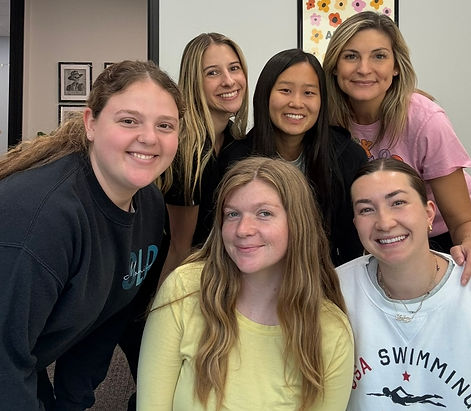
Meet Your Speech-Language Pathologists
Pediatric Therapy Playhouse was founded in 2013 by globally known speech-language pathologist and educator, Jessie Ginsburg, MS, CCC-SLP.
Our clinic attracts therapists from around the US because of our extensive training programs that are known around the world. Joining our team is highly competitive so you can rest assured that you will be working with a skilled, compassionate, and confident therapist.
All of our therapists are fully licensed speech-language pathologists who have a high level of training in early language development, autism support, speech sound production, and orofacial myology.
FAQs
Is my toddler a late talker or just taking their time?
Many toddlers catch up on their own, but some don't, and it's hard to tell which group a child is in by waiting. An evaluation looks at understanding, gestures, play and sounds, which helps predict whether your child is likely to catch up or would benefit from support.
Will my child grow out of a speech delay?
Some children do. Others continue to struggle, and those difficulties can affect reading, learning and confidence later on. Getting help early means you don't have to guess.
At what age can my child be evaluated?
We can evaluate children of any age, including babies. If you have concerns, there is no need to wait until a certain birthday.
Does screen time affect language development?
Young children learn language best through back-and-forth interaction with people. Screens can take time away from that, so we recommend keeping screen time limited and watching together when you can.
Is it normal for bilingual children to talk later?
Bilingual children may mix languages or know some words in only one language, which is normal. Learning two languages does not cause a delay. If you have concerns, we look at your child's skills across both languages.
Do I need a referral from my pediatrician?
This depends on your specific insurance plan. Once you're scheduled we will let you know if a referrals is needed and support you with obtaining one.
Does insurance cover speech and language therapy?
Many plans cover evaluations and therapy. We accept Anthem Blue Cross, Blue Shield, United Healthcare, and Cedars Sinai HMO plans. We offer self-pay rates of $140/session.