
Articulation Therapy & Orofacial Myofunctional Therapy
Clear speech helps children feel confident in class and when socializing with friends. When certain sounds are hard to make, or the mouth and tongue aren't resting and moving the way they should, targeted therapy can make a real difference.
At Pediatric Therapy Playhouse, we help children with speech sound difficulties, such as lisps and trouble with "r," and with orofacial myofunctional disorders, such as tongue thrust, open-mouth posture and lingering thumb-sucking habits.
Because speech and oral function are closely connected, we look at the whole picture to find what's really behind the challenge.

Speech Sound Therapy
A speech sound disorder means a person has trouble saying certain sounds clearly or uses sound patterns that are no longer expected for their age. It can make speech hard for others to understand, even when the person knows exactly what they want to say.

Types of speech sound difficulties we treat:
-
Articulation disorders: difficulty producing specific sounds, such as a lisp on "s" and "z" or saying "wabbit" for "rabbit"
-
Phonological disorders: patterns that simplify speech, such as "tat" for "cat" or "poon" for "spoon," that continue past the expected age
-
Childhood apraxia of speech (CAS): difficulty planning and coordinating the movements needed for speech, often causing inconsistent errors
-
Residual errors in older children and adults: sounds like "r," "s" or "l" that never fully developed
When are sounds expected?
Most speech sounds develop by age 5. There are certain sounds tht may be harder to make, and can take a bit longer, such as the "th" sound.
Signs it may be time for an evaluation
-
Your child is hard for family or teachers to understand
-
Your child is 4 or older and leaves off sounds or swaps sounds often
-
A lisp continues past age 5 or so, or the tongue pushes out between the teeth when speaking
-
Your child avoids talking or gets frustrated when not understood
Orofacial Myofunctional Therapy (OMT)
Orofacial myofunctional disorders (OMDs) are patterns in how the tongue, lips and jaw rest and move. These patterns can affect speech, chewing, swallowing, breathing and dental development. Orofacial myofunctional therapy uses targeted exercises and habit retraining to build healthier patterns.
Common signs of an orofacial myofunctional disorder
-
Tongue thrust: the tongue pushes forward against or between the teeth when swallowing or speaking
-
Open-mouth resting posture: lips often apart and the mouth open when relaxed
-
Mouth breathing during the day or at night
-
Low tongue resting posture: the tongue rests on the floor of the mouth instead of the roof
-
Prolonged thumb-sucking, finger-sucking or pacifier use
Who we help
We see children, including:
-
Referred by a dentist or orthodontist for tongue thrust or relapse concerns
-
Preparing for, going through or finishing orthodontic treatment
-
Before or after a tongue-tie release (frenectomy), working together with the treating provider
-
Ready to stop a thumb-sucking or pacifier habit
-
With a lisp connected to tongue position
Why Speech Sounds and Oral Function Go Together
The same muscles that help us swallow and rest our mouths are the ones we use to talk. A tongue that rests low or pushes forward can make sounds like "s," "z," "t," "d" and "l" hard to produce clearly.
Traditional articulation practice alone may not stick if the underlying oral pattern hasn't changed.
Because our clinicians are trained in both areas, we can tell whether a speech error comes from how sounds are learned, how the mouth moves at rest, or both. Then we treat the root cause, not just the symptom.
What to Expect: Evaluation & Therapy
The evaluation
Your first visit lasts about 30 minutes. Depending on your concerns, we may:
-
Listen to speech in words, sentences and conversation
-
Look at how the lips, tongue and jaw rest and move
-
Watch swallowing, chewing and breathing patterns
-
Check tongue mobility and screen for tongue-tie
-
Review dental, medical and feeding history
You'll receive a written report and a recommended plan
.
Speech sound therapy
Sessions are 30 minutes, usually twice weekly. For children, we use games and activities to practice target sounds in words, then sentences and conversation. Short daily home practice helps new sounds become automatic.
Orofacial myofunctional therapy
OMT is usually a structured program, with sessions two times per week. Each session teaches a few simple exercises to do at home for a few minutes a day.
Daily practice is the key to lasting results, so we keep exercises short and easy to fit into your routine.
We offer sessions in our clinic and by telehealth. OMT works especially well by telehealth for many clients.

Working With Your Dental and Medical Team

Oral function involves many specialists. With your permission, we coordinate care with:
-
Dentists and pediatric dentists
-
Orthodontists, to support treatment and help prevent relapse
-
Oral surgeons and frenectomy providers, for exercises before and after a tongue-tie release
-
ENTs and allergists, when mouth breathing may relate to airway issues such as enlarged tonsils or allergies
-
Pediatricians and sleep medicine providers
We'll refer you to the right specialist if we notice something outside our scope, such as a possible airway obstruction.
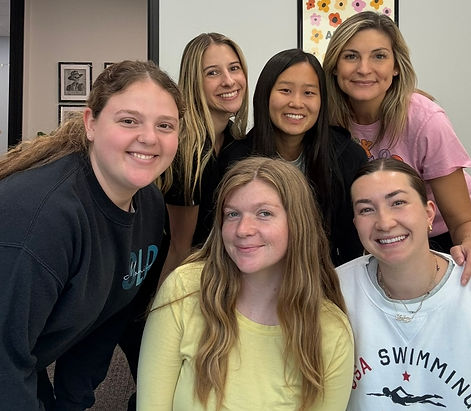
Meet Your Speech-Language Pathologists
Pediatric Therapy Playhouse was founded in 2013 by globally known speech-language pathologist and educator, Jessie Ginsburg, MS, CCC-SLP.
All of our therapists are fully licensed speech-language pathologists who have gone through orofacial myofunctional therapy certificate programs.
Our clinic attracts therapists from around the US because of our extensive training programs that are known around the world. Joining our team is highly competitive so you can rest assured that you will be working with a skilled, compassionate, and confident therapist.
FAQs
Will my child outgrow a lisp?
Some young children do, but a lisp that continues past age 5 or so, or one where the tongue pushes between the teeth, often needs support. An evaluation can tell you whether to wait or start therapy.
What is tongue thrust, and why does it matter?
Tongue thrust is when the tongue pushes forward against or between the teeth during swallowing or speech. Over time, this pressure can affect how teeth line up and can contribute to lisps or orthodontic relapse.
Do I need OMT before or after braces?
It depends on your situation. Many orthodontists like patients to start OMT during or before treatment so the new tongue patterns support the results. We're happy to talk with your orthodontist about timing.
Does my child need a tongue-tie release?
Not every child with a tight frenulum needs a release. We assess tongue function and can refer you to a provider for an evaluation. If a release is recommended, exercises before and after can support a better outcome.
Can OMT help with mouth breathing?
OMT can help retrain nasal breathing and lip-closed resting posture. If mouth breathing is caused by a blockage, such as enlarged tonsils or allergies, that needs medical care first, and we'll refer you.
How long does therapy take?
Speech sound therapy varies by the number of sounds and how long the error has been in place. OMT programs often last several months. Daily home practice makes the biggest difference in both.
Does insurance cover autism speech therapy?
Many plans cover speech-language evaluations and therapy. We accept Anthem Blue Cross, Blue Shield, United Healthcare, and Cedars Sinai HMO plans. We offer self-pay rates of $140/session.